Sep 27, 2026Success Stories
Restaurant and Cafe Terrace Lighting: A Practical Layout Plan with Wall and Path Lights
An application plan for outdoor dining terraces: how to zone the space, where wall lights and bollards belong, and a sample fixture list built from standard catalog models.
An outdoor terrace only earns its keep after sunset, and that comes down to lighting. Get it too bright and the terrace feels like a parking lot; too dim and guests end up reading the menu by phone light. What follows is a practical layout plan for restaurant and cafe terraces, built from standard wall-light and bollard ranges — adapt it to your own space, or hand it to a lighting supplier as a starting brief.
Start by Zoning the Terrace
Walk any terrace and you will find the same four lighting zones: the entrance, where guests form their first impression; the facade behind the seating, which sets the background brightness; the seating itself, where glare matters more than raw output; and the pathways and edges, where safety quietly beats mood. Light each zone on its own terms rather than washing the whole terrace with one bright layer — that is the difference between a planned terrace and a merely lit one.
Entrance and Facade: Set the Welcome
Flank the entrance with wall lights at eye level or a touch above, mounted so the light grazes the wall instead of glaring into the eyes of approaching guests. Warm light around 3000K reads as hospitality at dusk; save the cooler 6000K for entrances where visibility and security matter more than mood.
The Melong B1081 and B3032 wall lights suit this zone: die-cast aluminum housings, integrated LED, selectable 3000K, 4000K, or 6000K color temperature, a 110-240V range, and an IP65 rating for walls fully exposed to the weather.
Seating Area: Control Glare Before Brightness
Seated guests need the opposite of an entrance treatment: light that's low, warm, and shielded. Fixtures on adjacent walls or pergola posts at 3000K give food and faces a natural tone. The trick is placement — guests should never catch the light source directly from a seated angle. Graze a wall or the underside of a pergola instead, and the light spreads softly across the whole area.
That is why, where the seating sits under a covered pergola, the 8180H garden ceiling light is the catalog match: a die-cast aluminum fixture with an E27/E26 socket, an IP54 rating, and a black or white finish, so the venue can tune the mood simply by choosing the bulb.
Pathways and Edges: Guide the Feet
All evening, guests, staff, and trays cross and recross the terrace edges — which is why bollards belong along the walkways. They mark the route with pools of light at ground level instead of overhead glare. A common spacing is 1.5 to 3 meters: tighten it on steps, widen it on straight runs, and let the pools of light overlap slightly rather than leave dark gaps.
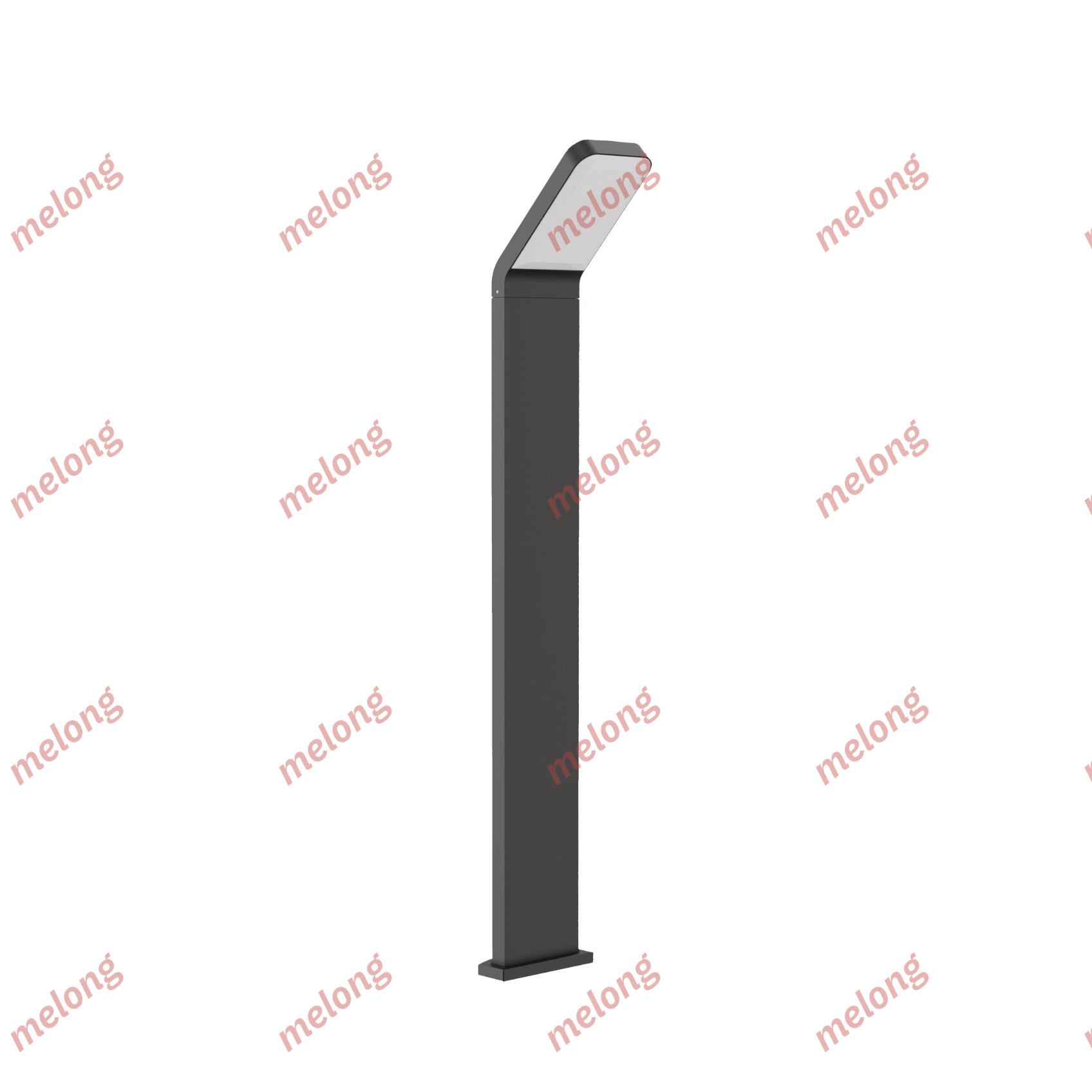
The B9016 and B9106-70 bollard lights carry the same die-cast aluminum construction, integrated LED, selectable 3000K, 4000K, or 6000K, and IP65 rating, which keeps the pathway layer consistent with the facade layer in both appearance and weather resistance.
A Sample Fixture List for a Mid-Size Terrace
To make this concrete, picture a terrace of roughly 120 square meters — fifteen tables, one entrance, a twelve-meter pathway. A sensible starting list from the Melong catalog: two B1081 wall lights flanking the entrance, four B3032 along the facade, two 8180H under the covered pergola section, and six B9016 bollards along the pathway at about two-meter spacing. Everything on the list shares the same 110-240V range, so the whole terrace runs on one electrical standard.
But treat the list as a template rather than a prescription: wider facades take more wall lights at closer spacing, and terraces without a pergola drop the ceiling layer and add bollards at the planting edges instead.
Adapting the Plan to Your Own Terrace
When you're ready to plan the lighting, send Melong Lighting the terrace dimensions, a photo of the space, and the mood you're after. We'll map the four zones onto your layout and propose a fixture list from the catalog — and if the venue wants a custom look, OEM and ODM options are on the table.